Healthcare AI Overviews Case Study: Analyzing Medical Clinic Visibility Growth
How a healthcare organization can evaluate its visibility in Google AI Overviews and AI Mode, worked through with an illustrative impressions dataset for Clínica Áurea, a multi-specialty clinic in Buenos Aires.
- Organization
- Clínica Áurea, multi-specialty medical clinic
- Location
- Recoleta, Buenos Aires, Argentina
- Specialties
- General medicine, dermatology, cardiology, gynecology, endocrinology
At a glance
This analysis looks at one narrow metric: how often Clínica Áurea's pages appeared in Google AI Overviews and AI Mode, as shown in the Generative AI features report in Google Search Console. Across the illustrative dataset, total impressions rose from 99 in the first seven days to 596 in the latest seven days, and from 810 in the first 30 days to approximately 2,060 in the latest 30 days.
Those are meaningful movements in visibility, but they start from small numbers and cover a short period. They show that the clinic appeared more often in Google's generative search features. They do not show why, and they say nothing about clicks, appointments, or patients. The sections below explain how to read figures like these, and how US medical practices can measure their own AI search visibility. For the clinic's overall organic performance, see the companion healthcare SEO case study.
7-day AI feature impressions
596
First 7 days: 99
+497 impressions
Latest 7 days (Nov 15–21, 2026) vs. first 7 days (Aug 25–31, 2026).
Illustrative 7-day growth
+502%
Avg. daily: 14.1 → 85.1
(596 − 99) ÷ 99. Two short windows with a low starting volume.
30-day AI feature impressions
~2,060
First 30 days: 810
≈ +1,250 impressions
Latest 30 days (Oct 23 – Nov 21, 2026) vs. first 30 days (Aug 25 – Sep 23, 2026).
Illustrative 30-day growth
~+154%
Avg. daily: 27 → ~68.7
(2,060 − 810) ÷ 810. Search Console shows the latest total rounded to 2.06K.
Impressions in Google AI Overviews and AI Mode only. Reporting windows overlap and are not additive.
The Healthcare AI Search Opportunity
Google now answers many searches with generated summaries. AI Overviews appear above the traditional results for some queries, and AI Mode offers a conversational search experience. Both can include links to the web pages they draw on. For a medical practice, that creates a new place to be seen: a patient asking which specialist treats a thyroid condition, or what to expect at a first dermatology visit, may see an AI-generated answer with source links before any organic listing.
Health searches are also where accuracy matters most. Google treats medical topics as "Your Money or Your Life" content, where trust and expertise carry extra weight. Being cited in an AI-generated answer about a health question is therefore both an opportunity and a responsibility: the pages that appear should be accurate, clearly sourced, and connected to services a patient can actually book.
The practical question for a healthcare organization is not whether AI search matters, but how to measure its own visibility there without overreading the data. That is what this case study is about.
| Search experience | What the patient sees | What Search Console can show |
|---|---|---|
| Traditional organic results | Ranked list of pages | Clicks, impressions, CTR, and position in the Performance report |
| Google AI Overviews | A generated summary with source links, above the results | Impressions in the Generative AI features report (Beta) |
| Google AI Mode | A conversational answer with source links | Impressions in the Generative AI features report (Beta) |
| ChatGPT, Claude, Perplexity, other assistants | Answers inside a third-party product | Nothing. These are not Google Search and are not reported in Search Console |
Understanding Clínica Áurea's Visibility Scenario
Clínica Áurea is a multi-specialty medical clinic in Recoleta, Buenos Aires, offering general medicine, dermatology, cardiology, gynecology, and endocrinology. Its public website is at aureaclinicamedica.space. A clinic like this competes for several distinct kinds of searches at once: condition questions, specialist searches, and local "near me" intent for each specialty.
The dataset covers impressions in Google's generative AI features from August 25 to late November 2026. Because several overlapping windows are discussed, the table below identifies each one. Two screenshots cover a slightly longer range than the window used in the analysis, and their captions say so.
| Reporting window | Dates (2026) | Days | Total impressions | Avg. daily impressions | Screenshot range |
|---|---|---|---|---|---|
| First 7 days | Aug 25–31 | 7 | 99 | 14.1 | Same window |
| Latest 7 days | Nov 15–21 | 7 | 596 | 85.1 | Same window |
| First 30 days | Aug 25 – Sep 23 | 30 | 810 | 27 | Aug 25 – Sep 24 (837) |
| Latest 30 days | Oct 23 – Nov 21 | 30 | ~2,060 | ~68.7 | Same window (2.06K) |
| Full period | Aug 25 – Nov 18 | 86 | ~3,700 | ~43 (calculated) | 3-month view through Nov 21 (3.93K) |
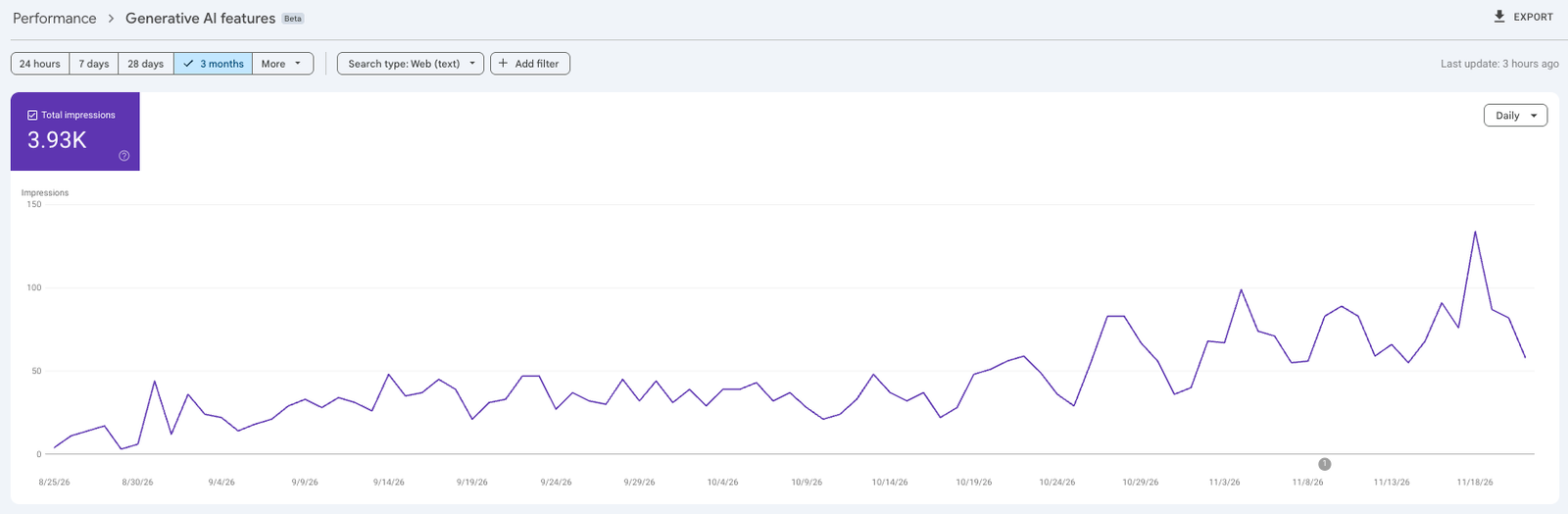
Search Console › Performance › Generative AI features (Beta): 3-month view from August 25, 2026, 3.93K total impressions
Google AI Overviews Performance: First vs. Latest 7 Days
The shortest comparison sets the first seven days of the dataset against the latest seven days. Total impressions rose from 99 to 596, an illustrative increase of approximately 502%. Average daily impressions moved from 14.1 to 85.1.
The percentage is large mainly because the starting point is small. In the first week, one day (August 31) accounted for 44 of the 99 impressions, and several days were in single digits. With a base that low, a handful of additional appearances moves the percentage a long way. The latest week is steadier, with every day well above the first week's daily average, but it also includes a visible single-day peak on November 18.
| Metric | First 7 days (Aug 25–31) | Latest 7 days (Nov 15–21) | Calculated change |
|---|---|---|---|
| Total impressions | 99 | 596 | +497; approximately +502% |
| Average daily impressions | 14.1 | 85.1 | +71.0 per day; about 6x |
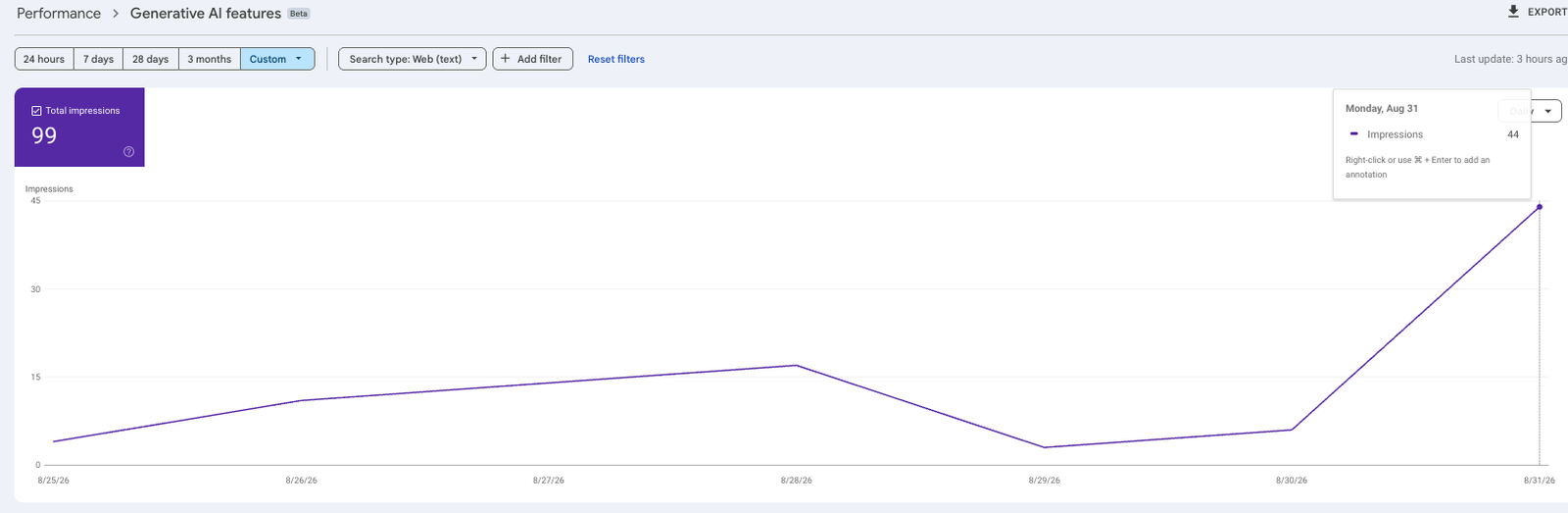
First 7 days: August 25–31, 2026, 99 total impressions
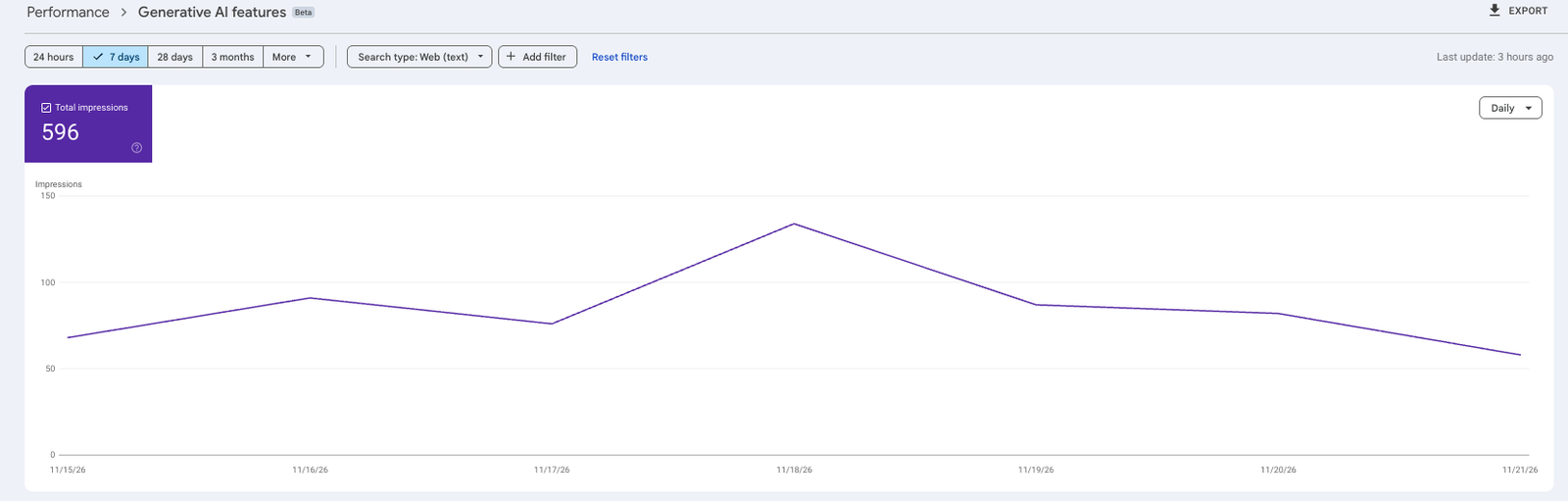
Latest 7 days: November 15–21, 2026, 596 total impressions
Supplied period totals only. No daily values are modeled.
The 30-Day Comparison: Understanding the Longer-Term Trend
A 30-day window smooths out much of the day-to-day noise. Total impressions rose from 810 in the first 30 days to approximately 2,060 in the latest 30 days, an illustrative increase of approximately 154%. Average daily impressions moved from 27 to approximately 68.7.
The 30-day increase is smaller than the 7-day increase, and that is expected. The first seven days were the lowest-volume stretch in the dataset, so a comparison anchored on them exaggerates the change. The 30-day comparison is the more reliable read of direction. It is also worth noting that the latest week's daily average (85.1) sits above the latest 30-day average (about 68.7), so the most recent week was stronger than the month around it. Whether that continues cannot be known from this data.
The longer view supports the same direction: across the full August 25 – November 18 window, the dataset contains approximately 3,700 impressions, and the 3-month screenshot shows a gradual rise rather than a single jump. Only Search Console's own chart is shown; no trend line has been fitted or projected.
| Metric | First 30 days (Aug 25 – Sep 23) | Latest 30 days (Oct 23 – Nov 21) | Calculated change |
|---|---|---|---|
| Total impressions | 810 | ~2,060 | ≈ +1,250; approximately +154% |
| Average daily impressions | 27 | ~68.7 | ≈ +41.7 per day; about 2.5x |
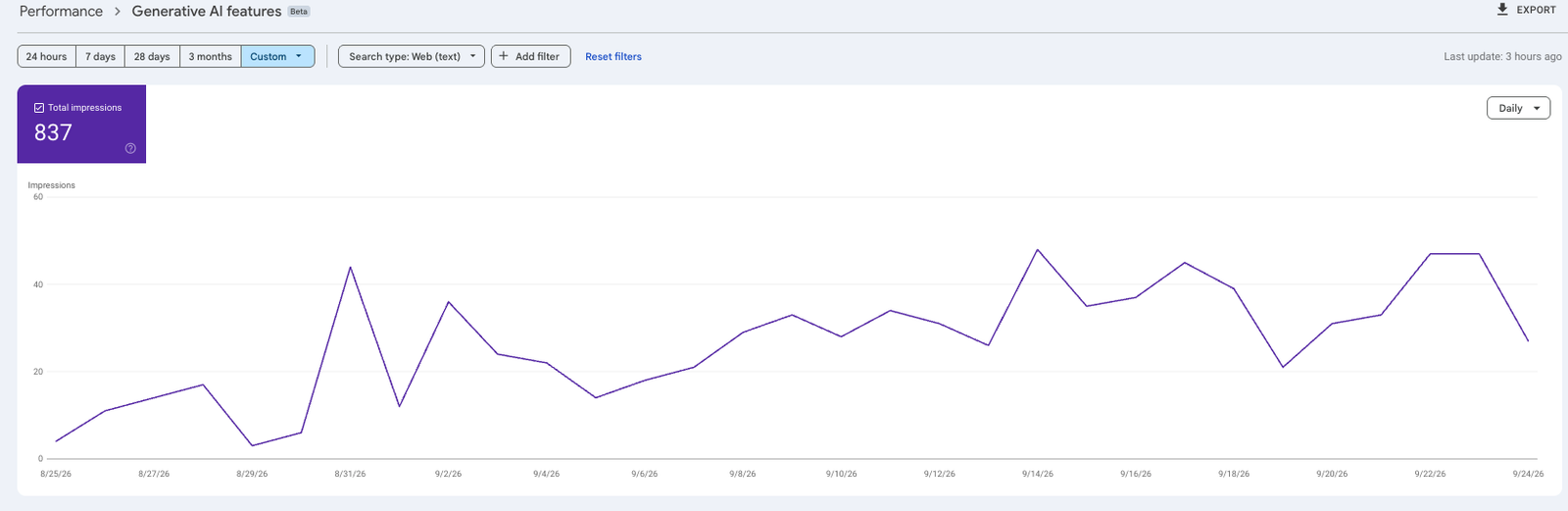
First 30 days: custom range August 25 – September 24, 2026, 837 total impressions
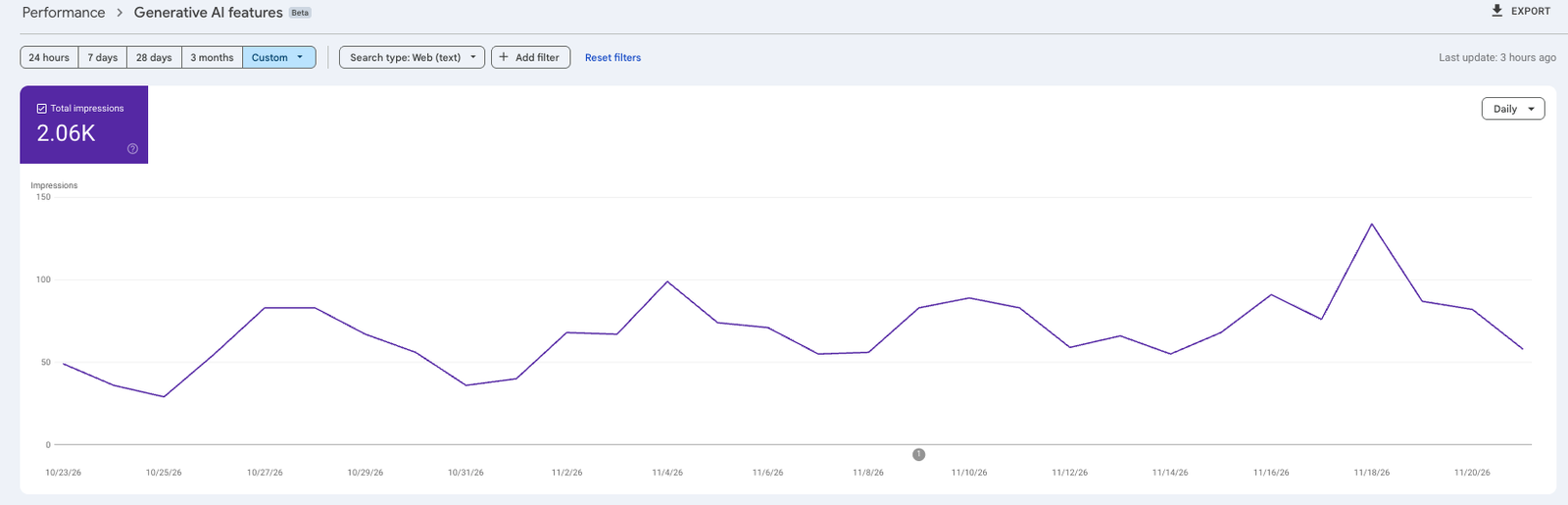
Latest 30 days: October 23 – November 21, 2026, 2.06K total impressions
Supplied period totals only. No daily values are modeled.
Healthcare SEO Strategies That May Support AI Search Discoverability
No implementation records exist for this period, so nothing below is presented as work performed for Clínica Áurea, and none of it is offered as the cause of the change in impressions. These are the practices we would review for any medical practice that wants to be a credible source for Google's generative features. Google states that AI Overviews and AI Mode draw on the same foundations as Search, and that pages need to be indexed and eligible to appear with a snippet; it does not describe a separate optimization method.
-
Technical SEO
Make sure key pages are crawlable, indexed, fast on mobile, and eligible for snippets.
-
Medical specialty pages
Give every specialty a dedicated page that answers what a patient needs to decide and book.
-
Content structure and topical relevance
Answer real patient questions clearly, and connect related conditions, services, and providers.
-
Local search intent
Keep location details accurate and reflect the areas the practice genuinely serves.
-
Medical accuracy and trust
Publish clinician-reviewed content and name reviewers only when review actually happened.
Technical SEO: eligibility comes first
A page cannot appear as a source in an AI feature if Google cannot crawl and index it. Check the Page indexing report for specialty and location URLs, remove accidental noindex tags or snippet restrictions on pages you want cited, and fix duplicate URLs created by booking widgets or parameters. A technical SEO review should end with a short, prioritized fix list.
Medical specialty pages
Generated answers to specialty questions tend to need a clear, specific source. A single services page listing every specialty is a weak candidate. Each specialty page should state who it is for, which conditions and services are offered, and how to book, so it can stand on its own as an answer to a patient's question.
Content structure and topical relevance
Organize content around the questions patients actually ask, with descriptive headings and direct answers near the top of each section. Link condition articles to the specialty page that treats them, and specialty pages to providers and booking. Our SEO content work follows this structure, with clinical review before publication.
Local search intent
Many healthcare searches are local even when they do not say so. Accurate practice details, a maintained Google Business Profile, and a dedicated location page help Google understand where a practice operates. See our local SEO services. No local ranking outcome is claimed for Clínica Áurea.
Medical accuracy and trust
Health content is held to a higher standard of accuracy and trust. Content should be reviewed by a qualified clinician, cite reputable sources where appropriate, and be kept up to date. Our healthcare SEO services apply these standards across technical, local, and content work.
How Medical Practices Can Measure Their Google AI Visibility
The Generative AI features report shown in the screenshots sits under Performance in Google Search Console and is labeled Beta. In the screenshots, it reports total impressions over a selected date range, with daily granularity, a search type filter (set to Web, text), date presets, filters, export, and chart annotations. Check Google's current Search Console Help for the exact definition of an impression in this report, since Beta reports can change.
| Question | Generative AI features report | Needs other sources |
|---|---|---|
| How often did our pages appear in AI Overviews and AI Mode? | Yes (impressions) | No |
| Did searchers click through to the site? | Not shown in these screenshots | Standard Performance report, analytics |
| Do we appear in ChatGPT, Claude, or Perplexity? | No | Those products' own tools or manual checks, where available |
| Did AI visibility lead to inquiries or appointments? | No | Analytics with conversion tracking, call tracking, scheduling data |
| Was a change caused by our SEO work? | No | A dated implementation log, plus controlled comparisons |
-
Compare equal windows
Set 7-day against 7-day and 30-day against 30-day, never a week against a month.
-
Use daily averages
Divide totals by days so windows of different lengths can be compared fairly.
-
Prefer longer windows
Treat 30-day and 3-month views as the read on direction; use 7-day views to spot changes.
-
Log your changes
Keep dated records of site changes so later movements can be checked against them.
-
Pair with other reports
Use the standard Performance report for clicks and analytics for inquiries.
Connect visibility to outcomes, carefully
Impressions are a leading indicator. To judge whether search visibility is helping the practice, connect organic landing pages to inquiries in analytics, and where systems allow, to booked appointments by source. A focused SEO audit can identify the gaps, and our healthcare marketing analytics work covers the reporting. US practices should review HHS guidance on online tracking technologies with their compliance team before adding tags to patient-facing pages.
Sources and Definitions
Clínica Áurea's pages appeared in Google's generative AI features more often in late November 2026 than in late August 2026, and the longer windows point in the same direction as the short ones. The sources below cover how AI Overviews and AI Mode work, how Search Console defines the metrics used on this page, and the content and privacy guidance relevant to healthcare websites.
- Google Search Central: AI features and your website — How AI Overviews and AI Mode work and what makes a page eligible to appear.
- Google Search Console Help: Performance report — Definitions of impressions and related metrics.
- Google Search Central: Creating helpful, reliable, people-first content — Content quality guidance.
- US HHS: Use of online tracking technologies by HIPAA covered entities — US privacy context for analytics on healthcare websites.
Frequently Asked Questions
What are Google AI Overviews and AI Mode impressions?
They count how often a site's pages appeared in Google's generative search features: AI Overviews, which show a generated summary above the results, and AI Mode, Google's conversational search experience. Search Console reports them in the Generative AI features report, which Google labels Beta. An impression means visibility, not a visit.
Do Google AI Overview impressions include ChatGPT, Claude, or Perplexity?
No. The report covers Google Search only. Visibility in ChatGPT, Claude, Perplexity, and other third-party assistants is not measured in Google Search Console and cannot be inferred from these figures.
Is a 502% increase in AI Overview impressions meaningful?
It is a real change in the data, but the percentage is large mainly because the starting week had only 99 impressions. Comparing equal 30-day windows gives a steadier read, which in this dataset was approximately +154%. Look at absolute numbers and longer windows before drawing conclusions.
Can AI Overview impressions show how many patients came from Google?
No. Impressions show how often a page was displayed. They do not show clicks, inquiries, appointments, or patients. Those require analytics with conversion tracking, call tracking or a CRM, and scheduling data, set up in a privacy-safe way.
How can a medical practice improve its chances of appearing in AI Overviews?
Google describes no separate optimization method. Pages need to be indexed and eligible to appear with a snippet, so the foundations are technical SEO, dedicated specialty pages, clear answers to real patient questions, accurate local information, and clinician-reviewed content. None of these guarantees inclusion.
Why compare 30-day windows as well as 7-day windows?
Short windows on low volumes are easily moved by a single busy day. In this dataset, one day accounted for 44 of the first week's 99 impressions. A 30-day window averages out that noise and gives a more reliable sense of direction.
How often should a medical practice check its AI Overviews impressions?
A monthly review alongside the regular Search Console performance report is a reasonable cadence for most practices. Because 7-day windows on lower-traffic sites can swing with a single busy day, a 30-day comparison gives a steadier read of direction between reviews.
Improve Your Healthcare Search Visibility
Request a healthcare SEO audit. We review indexation, specialty pages, local signals, content structure, and how you measure visibility in Google Search and its AI features, then give you a prioritized plan. No guaranteed rankings or AI citations.
Request a Healthcare SEO Audit →Have a question first? Contact our team.
Related healthcare SEO resources
Healthcare SEO case study: Clínica Áurea
The same clinic's overall organic Search Console performance: position, CTR, clicks, and impressions.
Learn more →Healthcare SEO services
How we approach technical, local, and content SEO for healthcare organizations.
Learn more →Local SEO services
Location pages, Google Business Profile, and local relevance for practices.
Learn more →Technical SEO services
Crawling, indexation, and page experience fixes, prioritized.
Learn more →