Healthcare SEO Case Study: Improving a Medical Clinic's Organic Search Visibility
A transparent analysis of Search Console data from Clínica Áurea, a multi-specialty clinic in Buenos Aires, and the healthcare SEO framework US medical practices can apply to the same visibility problem.
- Organization
- Clínica Áurea, multi-specialty medical clinic
- Location
- Recoleta, Buenos Aires, Argentina
- Specialties
- General medicine, dermatology, cardiology, gynecology, endocrinology
Executive summary
Clínica Áurea is a multi-specialty medical clinic in Recoleta, Buenos Aires, offering general medicine, dermatology, cardiology, gynecology, and endocrinology. At baseline, its Google Search Console data showed an average position of 54 and an average CTR of 0.4%, meaning the site was rarely seen and rarely chosen in organic search. In a later snapshot covering August 16 – November 15, 2026, the site recorded 5,420 clicks from 188,000 impressions, a 2.9% average CTR, and an average position of 11.6.
For a clinic, organic discoverability matters because it determines whether people researching symptoms, specialists, or local care ever reach the practice. These are observed metrics, however, not proof of cause. The data shows that visibility changed; it does not show exactly why, or whether more patients booked appointments.
Average position
11.6
Baseline: 54
42.4 positions lower (numerically)
Aggregate of the site's topmost position across searches. Not the ranking of every keyword.
Average CTR
2.9%
Baseline: 0.4%
+2.5 percentage points (7.25x baseline)
Clicks divided by impressions across all queries in the period.
Organic clicks
5,420
Baseline: 271
+5,149 clicks (+1,900%)
Clicks from Google organic results to the site.
Organic impressions
188,000
Baseline: 67,680
+120,320 impressions (+177.8%)
Times a site URL appeared in a user's search results.
Later snapshot: August 16 – November 15, 2026. Supplied client figures.
The initial challenge: what an average position of 54 and a 0.4% CTR indicate
The baseline numbers describe a site that Google was showing, but rarely in places where people look. No historical audit was supplied, so this section explains what the metrics typically indicate rather than listing specific problems found on the clinic's site.
What an average position of 54 means
Google Search Console reports average position as the average of the topmost position a site held across the searches in which it appeared. A figure of 54 is consistent with most visibility landing on page five or beyond, where very few searchers ever scroll. It can also hide a mix: a handful of strong rankings for branded searches combined with a long tail of weak placements for service and condition queries.
Because it is an average, position should never be read as the ranking of a single keyword. It changes when rankings change, but also when the set of queries a site appears for changes.
What a 0.4% CTR means
Click-through rate is clicks divided by impressions. At 0.4%, roughly four clicks were earned for every 1,000 times the site appeared. A CTR this low usually follows from deep average positions: listings on later pages are counted as impressions when loaded, but rarely clicked. Title tags and meta descriptions that do not match what a patient searched for can push CTR lower still.
Why multi-specialty clinics struggle in local organic search
A clinic offering five specialties competes in five different search landscapes. Someone searching for a dermatologist is not comparing the same results as someone looking for a cardiologist or an endocrinologist. Each specialty has its own competitors, including single-specialty practices, hospital systems, physician directories, and health publishers.
Common structural issues for multi-specialty clinics include a single generic services page instead of dedicated specialty pages, thin location signals, and condition content that is not connected to the service a patient can actually book. Any of these can keep a clinic's pages from being considered relevant for high-intent local searches. Whether they applied to Clínica Áurea cannot be confirmed from the supplied data.
The healthcare SEO methodology: a recommended seven-part framework
Implementation records for this project were not available. The framework below is therefore presented as the recommended methodology for a multi-specialty clinic in this position, not as a verified account of work performed for Clínica Áurea. Each step includes the operational checks we would prioritize.
-
Technical SEO and indexation
Make sure the pages patients need can be crawled, indexed, and loaded quickly on mobile.
-
Specialty-based keyword research
Map search demand separately for each specialty, condition, and procedure.
-
Service page optimization
Give every specialty a dedicated, useful page that matches patient intent.
-
Local search strategy
Align location signals, Google Business Profile details, and local page content.
-
Healthcare content and medical expertise
Publish accurate, clinician-reviewed content that answers real patient questions.
-
Internal linking and topical coverage
Connect conditions, services, and providers so each topic is easy to navigate.
-
Measurement and iteration
Track query, page, and inquiry data, then reprioritize based on evidence.
1. Technical SEO and indexation
Start with the Search Console Page indexing report: which specialty and location URLs are excluded, and why. Typical checks include duplicate pages created by booking widgets or URL parameters, specialty pages that are only reachable through a search box, slow mobile templates, and missing or conflicting canonical tags. A technical SEO review should end in a short, prioritized fix list, not a 200-row export.
2. Specialty-based keyword research
Research each specialty as its own market. For dermatology, that may mean separating condition searches (such as acne or psoriasis), procedure searches, and provider searches. For cardiology, diagnostic tests and second-opinion searches often matter. Group queries by intent: informational, local provider, and appointment-ready. This prevents one page from trying to rank for everything.
3. Service page optimization
Each specialty page should explain who it is for, which conditions and services are offered, how to book, and what to expect at a first visit. Write title tags that reflect the specialty and location a patient would search for. A practical test: could a patient decide whether to book from this page alone? If not, the page is probably too thin to rank or convert.
4. Local search strategy
Google says local results are based mainly on relevance, distance, and prominence. Practical work includes accurate and consistent practice details, a well-maintained Google Business Profile, a dedicated location page, and content that reflects the neighborhoods the clinic genuinely serves. See our local SEO services for how we approach this. No Google Maps ranking outcome is claimed for this clinic.
5. Healthcare content and medical expertise
Health topics are what Google's quality rater guidelines call "Your Money or Your Life" (YMYL) topics, where accuracy and trust carry extra weight. Content should be planned around real patient questions, written clearly, and reviewed by a qualified clinician before publication, with reviewer names shown only when that review actually happened. Our SEO content work follows the same rule.
6. Internal linking and topical coverage
Link condition articles to the specialty page that treats them, specialty pages to relevant provider and location pages, and every page to a clear booking path. Use descriptive anchor text, such as "thyroid evaluation with an endocrinologist," instead of "click here." This helps search engines and patients understand how topics relate.
7. Measurement and iteration
Review Search Console at the query and page level, not only the site-wide average. Separate branded from non-branded queries, and track each specialty as its own segment. Then connect organic landing pages to inquiries in analytics and, where available, to bookings. Reprioritize monthly based on which specialties gain impressions but not clicks, or clicks but not inquiries. Our healthcare marketing analytics work covers that connection.
Performance analysis: what the Search Console data shows
The table compares the baseline period with the later snapshot. The final CTR is consistent with 5,420 clicks from 188,000 impressions, allowing for rounding.
| Metric | Baseline (period not provided) | Later snapshot (Aug 16 – Nov 15, 2026) | Calculated comparison |
|---|---|---|---|
| Average position | 54 | 11.6 | Improved 42.4 positions (numerically) |
| Average CTR | 0.4% | 2.9% | +2.5 percentage points; 625% relative increase; 7.25x baseline |
| Organic clicks | 271 | 5,420 | +5,149 clicks; +1,900% |
| Organic impressions | 67,680 | 188,000 | +120,320 impressions; +177.8% |
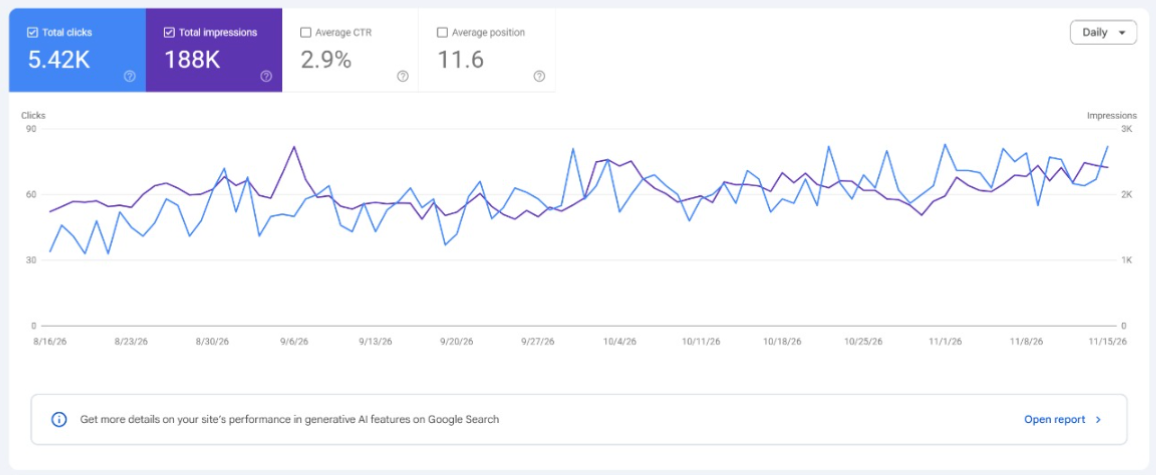
Search Console performance report supplied by the client, August 16 – November 15, 2026
Average position: 54 to 11.6
An average of 11.6 suggests that much of the site's visibility moved toward the first and second pages of results. It does not mean every keyword ranks near position 11. Averages also shift when the query mix changes: if a site stops appearing for many irrelevant, low-ranking queries, its average can improve even when individual rankings stay flat.
Average CTR: 0.4% to 2.9%
CTR increased by 2.5 percentage points, a 625% relative increase; the final CTR is 7.25 times the baseline. Better average positions usually lift CTR, so the two metrics are not independent evidence. Branded queries, which tend to have high CTR, can also raise the average. A branded versus non-branded split was not supplied.
Clicks and impressions: baseline versus later snapshot
Impressions count how often a site URL appeared in search results; clicks count how often a searcher clicked through to the site. Baseline impressions (67,680) and clicks (271) compare with 188,000 impressions and 5,420 clicks in the later snapshot, a +177.8% and +1,900% change respectively.
What healthcare businesses can learn
The SEO method below is what transfers to US providers; regulatory and privacy obligations are specific to each market and must be assessed locally.
Independent US medical practices
Check average position and CTR by page, not only site-wide. A practice with a low CTR on its core service pages often has a relevance problem, a snippet problem, or both. A focused SEO audit is usually a better first step than producing more content. Our medical practice marketing page explains how this fits a wider acquisition plan.
Multi-specialty clinics
Treat each specialty as its own SEO segment with its own pages, queries, and reporting. A site-wide average can look healthy while one specialty has almost no visibility.
Dermatology practices
Separate medical dermatology from cosmetic services in both pages and measurement. The searchers, competitors, and booking paths are usually different.
Cardiology practices
Many cardiology patients arrive through referrals, so organic search often supports research and trust rather than first discovery. Pages for diagnostic tests and conditions should be accurate, clinician-reviewed, and connected to clear referral and scheduling information.
Dental clinics
Dental search is heavily local and service-specific. Dedicated pages for high-value services, accurate location data, and a fast mobile booking path tend to matter more than broad educational content. See dental marketing for related services.
Outpatient medical providers
Urgent care, imaging, and outpatient centers should make hours, accepted insurance, locations, and service availability easy to find and consistent everywhere they appear.
Generalizable principles versus country-specific requirements
Search fundamentals such as crawlability, relevance, local signals, and helpful content apply across markets. Privacy rules do not. HIPAA is a US framework and does not govern a clinic in Argentina, which is subject to Argentina's own data protection law (Law No. 25,326). This page makes no compliance claim about the clinic. US practices should review HHS guidance on online tracking technologies with their compliance or legal team before adding analytics or advertising tags to patient-facing pages.
SEO visibility versus patient acquisition
Higher search visibility is the start of the patient journey, not the end. More clicks do not automatically mean more patients. Each stage below needs its own measurement, and only the first two are visible in Search Console or web analytics.
| Question | Search Console | Needs other systems |
|---|---|---|
| Are we visible for specialty searches? | Yes (impressions, position) | No |
| Are searchers clicking through? | Yes (clicks, CTR) | No |
| Which pages produce inquiries? | No | Analytics with conversion tracking |
| Are inquiries qualified? | No | Call tracking, CRM, intake review |
| Did inquiries become appointments and patients? | No | Scheduling and practice management data |
For Clínica Áurea, only Search Console-level data was supplied. No inquiry, appointment, or patient data is reported or implied.
-
Search visibility
Impressions and average position. Measured in Search Console.
-
Organic visits
Clicks in Search Console; sessions and landing pages in analytics.
-
Qualified inquiries
Forms and calls, filtered for real patients. Analytics plus call tracking or CRM.
-
Appointments
Booked visits by source. Scheduling or practice management system.
-
New patients
Attended first visits. Practice management or EHR reporting, kept privacy-safe.
Sources and editorial accountability
This analysis was prepared by The Pitch Room using figures supplied by Clínica Áurea. Definitions of search metrics and quality guidance are drawn from the sources below.
- Google Search Console Help: Performance report (Search results) — Definitions of clicks, impressions, CTR, and average position.
- Google Search Console Help: What are impressions, position, and clicks? — How position and impressions are counted.
- Google Search Central: Creating helpful, reliable, people-first content — Content quality and E-E-A-T guidance.
- Google Search Quality Rater Guidelines — YMYL topics and page quality.
- Google Business Profile Help: How to improve your local ranking on Google — Relevance, distance, and prominence.
- US HHS: Use of online tracking technologies by HIPAA covered entities — US privacy context for analytics on healthcare websites.
Frequently asked questions
What is a good average position in Google Search Console for a medical practice?
There is no universal target. Average position blends every query a site appears for, including branded searches and loosely related terms. It is more useful to review position for your priority specialty and location queries, page by page. A practice can have a modest site-wide average and still rank well for the searches that bring in patients.
Why is a clinic's organic CTR low even when it appears in Google?
Low CTR usually means the site appears too far down the results to be clicked, or its titles and descriptions do not match what the searcher wanted. Results pages crowded with ads, map listings, and other features can also lower clicks. Review CTR by query and page to see which cause applies.
Can Google Search Console show how many patients came from SEO?
No. Search Console reports what happens in Google Search: impressions, clicks, CTR, and position. It cannot see inquiries, appointments, or patients. Those require analytics with conversion tracking, call tracking or a CRM, and scheduling data, set up in a privacy-safe way.
Should a multi-specialty clinic create a separate page for each specialty?
In most cases, yes. Patients search for a specific specialty or condition, and a single page listing every service rarely satisfies that intent. A dedicated page for each specialty, linked to related conditions, providers, and booking information, gives search engines and patients a clearer match.
How should you evaluate a healthcare SEO case study?
Check whether it states the reporting periods, gives baseline and later figures for the same metrics, and separates observed data from claims about cause. Be cautious of percentage growth figures with no baseline, rankings presented as patient outcomes, and results with no indication of how they were verified.
Does medical content need clinician review to perform in search?
Google does not require a specific credential to rank, but health topics are treated as Your Money or Your Life content, where accuracy and trust carry extra weight. Clinician review is the responsible standard for patient safety. Only name a reviewer when that review genuinely took place.
Do SEO results from a clinic outside the US apply to US practices?
The search principles generally transfer: technical health, relevance, local signals, and helpful content work similarly across markets. Competition, search behavior, and regulation differ. US practices also need to consider HIPAA and state rules when setting up tracking and content, which do not apply to a clinic in Argentina.
Find Out What's Holding Your Medical Practice Back in Google Search
Request a healthcare SEO audit. We review indexation, specialty and service pages, local signals, and measurement, then give you a prioritized plan. No guaranteed rankings, just a clear view of what to fix first.
Request a Healthcare SEO Audit →Have a question first? Contact our team.
Related healthcare SEO resources
Healthcare SEO services
How we approach technical, local, and content SEO for healthcare organizations.
Learn more →Healthcare digital marketing
SEO, PPC, conversion optimization, and analytics for healthcare providers.
Learn more →Medical practice marketing
Patient acquisition for independent and multi-provider practices.
Learn more →Healthcare marketing analytics
Connecting search and site data to qualified inquiries and bookings.
Learn more →